Data Regulations by Country
How to comply with privacy laws in Latin America without the stress?
At SafeData, we help your business adapt smoothly and securely to the data protection regulations of Chile, Mexico, Colombia, and Brazil.
Select a country below to learn about its legislation, prevent costly fines, and design your software and technology infrastructure with best security practices from day one.
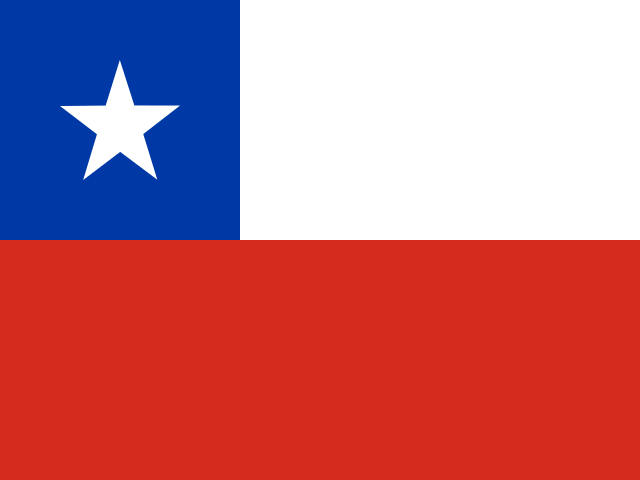
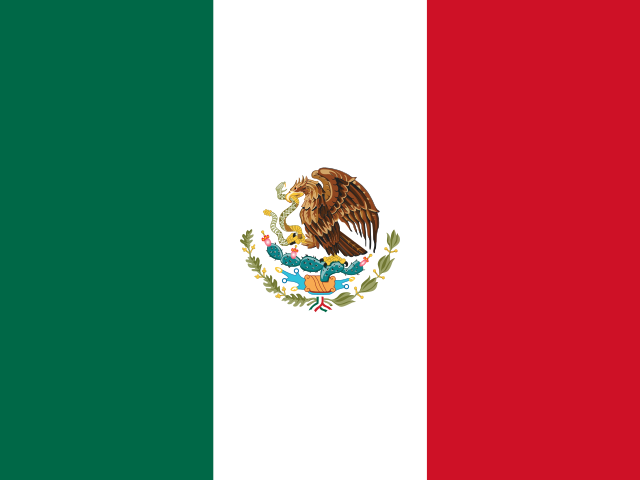
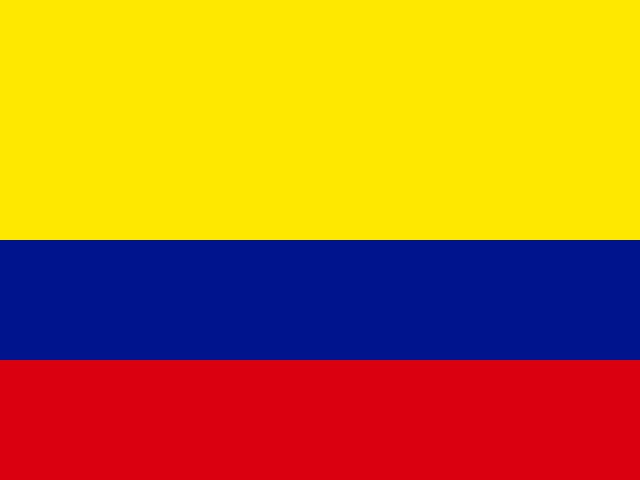
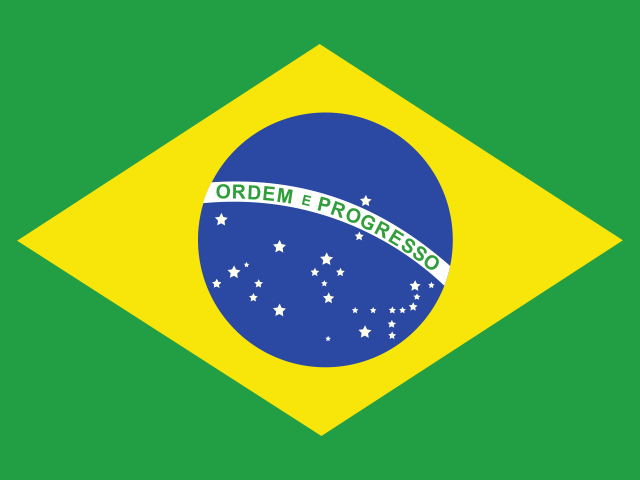
Chile View Official Law
1. The Law
Law N° 21.719 (Personal Data Protection) Establishes the new Personal Data Protection Agency and redefines the handling of and rights over citizens’ data in Chile, aligning with global privacy standards.
2. Risks and Sanctions
- Infraction Classifications: Violations are classified into minor, serious, and very serious depending on their impact on data subjects.
- Fine Scale: Fines of up to 5,000 UTMs for minor infractions, up to 10,000 UTMs for serious infractions, and up to 20,000 UTMs for very serious infractions.
- Large Company Repeat Offenders: If non-SMEs repeat serious or very serious violations, the fine can reach up to 1% or 3% of their annual sales and services revenue in the preceding calendar year, respectively.
- National Registry: Imposed sanctions are public and registered in the National Registry of Sanctions and Compliance of the Personal Data Protection Agency.
3. Impact on Architecture and Software
- Mandatory Encryption: Encryption of personal data both in transit (TLS) and at rest (AES-256).
- Privacy by Design: Modular design of relational and non-relational databases that allows purging, anonymizing, or transferring information at the user’s request.
- Consent Management: Implementation of interfaces that record explicit and granular acceptance of terms.
Mexico View Official Law
1. The Law
LFPDPPP (Federal Law on the Protection of Personal Data Held by Private Parties) Regulates personal data processing by private companies, with special emphasis on obtaining explicit consent and strict protection of sensitive personal data.
2. Risks and Sanctions
- INAI Administrative Fines: Fines ranging from 100 to 160,000 times the UMA (Unit of Measure and Update) for standard violations, and 200 to 320,000 UMAs for serious violations.
- Sensitive Data Clause: If the violation involves sensitive personal data (health, biometric, financial), the fines can be doubled (up to 640,000 UMAs).
- Criminal Liability (Prison): Prison sentences of 3 months to 3 years for causing database security breaches for profit, and 6 months to 5 years for deceptive processing of data for profit (sentences are doubled for sensitive data, up to 10 years of imprisonment).
- Reiteration Penalties: If violations repeatedly persist, an additional fine ranging from 100 to 320,000 times the UMA is applied.
3. Impact on Architecture and Software
- Sensitive Data: Storage of biometric, financial, or health data in repositories with asymmetric encryption and strict key control.
- ARCO Rights: Implementation of automated API endpoints to securely process Access, Rectification, Cancellation, and Opposition requests.
- Traceability: Detailed logs of who accesses what data and for what purpose.
Colombia View Official Law
1. The Law
Law 1581 of 2012 (General Habeas Data Regime) Develops the constitutional right of citizens to know, update, and rectify information collected about them in databases or files.
2. Risks and Sanctions
- SIC Successive Fines: Personal and institutional fines of up to 2,000 legal monthly minimum wages (SMLMV) at the time of the sanction. Fines can be successive (cumulative) for as long as the non-compliance continues.
- Operational Suspension: Temporary suspension of activities related to data processing for up to six (6) months, requiring corrective actions.
- Closure of Operations: Temporary closure of operations following suspension if corrections are not met, and immediate and permanent closure of operations processing sensitive personal data in the case of a severe violation.
- Disciplinary Liability: In the case of public entities, suspected violations are forwarded directly to the Procuraduría General de la Nación for disciplinary investigations.
3. Impact on Architecture and Software
- Proof of Consent: Storage of immutable audit logs (protected logs) that prove how, when, and under what terms the user’s authorization was obtained.
- Minors’ Data: Special isolation and encryption of data corresponding to minors.
- Granular Revocation: Enable users to revoke permissions granularly (e.g., revoking marketing without affecting the contracted service).
Brazil View Official Law
1. The Law
LGPD (General Data Protection Law - Law No. 13,709/2018) Regulates the processing of personal data of individuals in Brazil, regardless of where the company’s headquarters are located or where the data is stored.
2. Risks and Sanctions
- ANPD Simple Fines: Fines of up to 2% of the company’s gross revenue (or group/conglomerate) in Brazil for the preceding fiscal year, net of taxes, capped at an absolute limit of R$ 50,000,000.00 (fifty million Reais) per infraction.
- Daily Fines: Imposed to enforce compliance, subject to the same R$ 50 million total cap.
- Blocking and Erasure: Temporary blocking of personal data until regularized, or full deletion (erasure) of the non-compliant personal data.
- Processing Prohibition: Partial or complete prohibition of data processing activities, effectively halting the organization’s data operations.
3. Impact on Architecture and Software
- International Transfers: Automated tracking and reporting of personal data flows leaving Brazil.
- Microservices Communication: Internal encryption of all requests (mTLS) sharing personally identifiable information.
- DPO Portal: Implementation of direct communication interfaces with the Data Protection Officer (DPO) to resolve requests within legal timeframes.